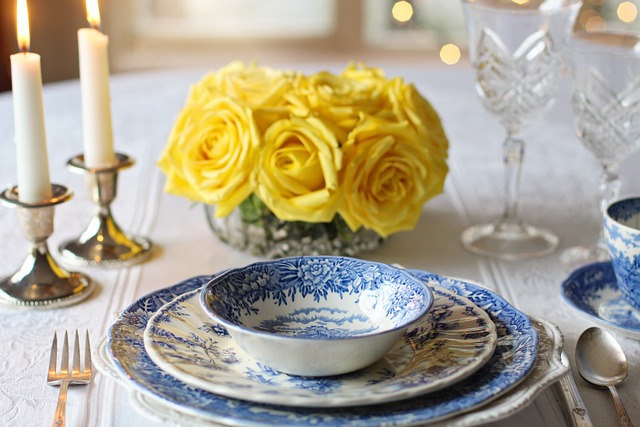
The Blue Willow china pattern became extremely popular in America once the “Blue Plate Special” menus…along with the “meat and three” style of diners…became the latest and greatest trend.
But the real reason I have written about the Blue Willow china pattern is because of its role in American history – the Blue Plate Special.
In the late 1920s, the “Blue Plate Special” became a cultural phenomenon.
Restaurants and diners recognized that many of their patrons had fallen on truly hard times.
To help their hardworking and budget-conscious patrons, restaurants and diners began offering them hearty and affordable meals.
These meals were much like the “Blue Plate” meals that had previously been advertised by the Harvey House establishments.
Many of these affordable meals were served on inexpensive Blue Willow grill plates. Grill plates are plates with divided sections
Blue Willow china became viral during the 1920s and and remained in high demand throughout the Great Depression,
American households also quickly adopted this trend also.
Today, the Blue Willow china pattern means more than just tableware to many people.
The pattern also represents comfort and tradition.
The pattern reminds us of the resilience that Americans had to find during such challenging economic times as the Great Depression.
The Blue Willow china pattern also hearkens back to a time when life, and the foods that we enjoyed, were both supposedly so much simpler…
The Blue Willow china pattern has been in production ever since being first introduced in the 1700s.
Before the 1700s, china was a luxury item owned only by European royalty and the elite.
Fine china was only painted by hand.
Fine china was most likely imported to Europe from Japan.
However, a new technique called the transfer method changed all that.
Transferware no longer required that intricate designs be created by hand. Instead, this new process uses copper plates to create the designs.
Transferware could be mass-produced, finally making decorative tableware affordable to middle-class households.
In the 1790s, thirty years after the development of the transfer method, Spode began mass-producing Blue Willow pieces.
This Blue Willow pattern would become one of the most recognizable and most popular patterns in history.
The Blue Willow china pattern has never been out of production since first being produced during the late 1700s.
Over 400 British china manufacturers have produced the Blue Willow china pattern at some point, including:
- Alfred Meakin
- Churchill
- Homer Laughlin
- Japan Co.
- Johnson Bros
- Myott Staffordshire
The Blue Willow china pattern has its own cult following.
The International Willow Collectors club regularly holds conventions and meetings to display and discuss Blue Willow china.
The Blue Willow china pattern is an early example of “false advertising.”
Although this was the supposed story told by the Blue Willow china pattern, it wasn;t Chinese at all.
In fact, the supposed Chinese folk tale has no known links to China.
Instead, the story most likely was a tactic designed by English potteries to market their goods.
The Blue Willow china pattern is an example of great storytelling.
The pattern tells a heart-wrenching story of forbidden, star-crossed love.
Tso Ling, a wealthy merchant, lived in a beautiful pagoda located under a pine tree next to a bridge with his beautiful daughter, Kwang-se.
Ling promised his daughter’s hand in marriage to a wealthy businessman associate of his.
He did not know that Kwang-se had fallen love with Chang, his kind, handsome clerk…who was also, unfortunately, very poor.
After finding out about the secret relationship, he became furious and kept his daughter locked away..
However, his daughter and the young clerk managed to elope across the sea to a cottage.
Ling would not stand for this and went after them by boat.
He was about to have them killed…
But the gods intervened and transformed the lovers into turtle doves.
The Blue Willow china pattern is an intricate design and always includes the same unique elements.
Authentic Blue Willow china always includes the following elements in the design:
- Boat
- Bridge with three men crossing it
- Ornate fence
- Pine trees to represent longevity
- Teahouse or pagoda
- Two doves at the top of the design gazing into each other’s eyes while flying to signify forbidden romance
- Willow trees to symbolize resilience
The Blue Willow china pattern is one of the oldest examples of influencing.
During the late 1700s and 1800s, it was rumoured that even royalty had a set of Blue Willow china in her dining room…and of course, everyone wants what royalty already has.
Another influences who made the Blue Willow china pattern popular is William Randolph Hearst, the American press magnate.
Hearst commissioned a special gold-rimmed version of Blue Willow china for his San Simeon castle…most likely so that his china could not be mistaken for the lower-cost, widely available pattern owned by non-billionaires.
The Blue Willow china pattern represents the artistic exchange between two cultures.
During the 17th and 18th centuries, European ‘s royalty and elites developed a fascination for Chinese design.
This Europeans passion became known as “chinoiserie.”
Although the Blue Willow pattern is inspired by Chinese culture, the actual design has been adapted to European tastes and perspective.
The Blue Willow china pattern reaches beyond the world of ceramics and fabrics.
The Blue Willow pattern is a source of inspiration for several artistic works, including a 1901 comic opera, a 1914 silent film, a 1992 animated short and .The Willow Pattern Story, a children’s story written by Allan Drummond.
The pattern is also featured in The Andy Griffith Show and Murder, She Wrote.
 Bless Her Heart
Leave a comment