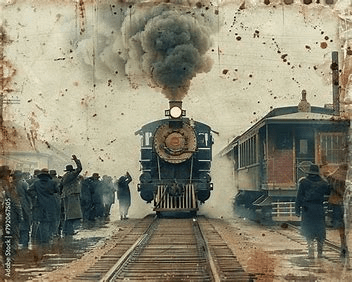
The chain of Harvey Houses that originated along the Atchinson, Topeka & the Santa Fe Railway (AT&SF) route.
These “eating houses” and hotels were the brainchild of English immigrant Fred Harvey.
Harvey partnered with AT&SF in building these “eating houses” after recognizing the terrible dining options available to travelers along the booming railroad networks.
(map)
At the peak of operations, there were nearly 100 restaurants.
This was the first chain of restaurants in America.
There were 60 restaurants and dining cars in 12 states…covering the area from Chicago to Galveston…and as far out yonder as San Francisco and Los Angeles.
The Harvey Houses became the sixth largest food retailer in the country.
Eighteen of these Harvey House locations were in Texas.
1911
Before the railroad boom, towns were few and far between.
As the railroads expanded westward, a Harvey House was set up every 100 miles…wherever the train had to stop to refuel the engines with water and coal.
Towns would then blossom at the location of the Harvey Houses.
Slaton, Texas is one of these towns that developed along the railroad. The town was named after a local rancher.
In 1911, the town was intentionally built as a hub of operations for AT&SF.
A year later, a Harvey House opened in Slaton…allowing passengers passing through Slaton a chance to come in and eat quality food.
The Slaton Harvey House operated for 30 years.
The town of Slaton grew around it.
Today the Slaton Harvey House is one of six remaining Harvey Houses in Texas.
Harvey Girls
The first group of Harvey Girls served here in Slaton, Texas.
As the railroads expanded westward, workers also had to be brought into these newly established towns to staff the new Harvey Houses.
Male servers could not be depended upon to keep the Harvey Houses running at top speed.
Male servers tended to be late to work, to become town drunks and to misbehaving while working at the Harvey Houses.
Harvey advertised the need for ““young, unmarried women of good moral character.”
These ads appeared in midwestern and eastern newspapers and magazines.
Thousands of women applied for these jobs.
At that time when only 15% of women worked outside the home.
Being selected as a Harvey Girl was both a challenge and an honor.
To become a Harvey Girl, you first had to sit through a very long interviewed. Then after six weeks of training and signing an affidavit attesting to maintain exemplary character, they could finally become a Harvey Girl.
This was a precursor to the days of the first airline stewardesses and the Rosie the Riveters in the decades to follow.
Harvey Girls gave over 100,000 young women a rare chance to explore life outside of their local communities, earn their own money, open bank accounts and even become homeowners.
The women earned $17.50 per month, a third more than waitresses typically made during that timeframe…in addition to generous tips from appreciative travelers and safe room and board.
These women offered travelers along the AT&SF the experience of fine dining and genteel respectability.
They also left behind a legacy that helped change the course of women’s history in the American southwest….in an era and locale often regarded as the domain of rugged cowboys and stoic ranchers.
In 1942, the Slaton Harvey House closed.
Larger and faster steam engines meant fewer refueling stops along the railroad routes.
Dining cars also were available in the trains themselves.
The Slaton Harvey House became a passenger and freight depot until being boarded up in the 1980s.
In 1989, the Slaton Harvey House was prepared for demolition.
But as the demolition crew showed up, they were greeted by Slaton residents and officials.
At the last minute, these residents and officials saved the building from being demolished.
These residents and officials made preserving the history of the Slaton Harvey House a priority.
Over $2 million were raised to restore Slaton’s iconic building.
Today the Slaton Harvey House is owned and operated by the Slaton Railroad Heritage Association, a 501 (c) (3) non- profit organization.
The Slaton Harvey House is one of only six remaining Harvey Houses that has not been demolished in Texas.
The Slaton Harvey House is also the only Harvey House in Texas that offers visitors an opportunity to stay overnight in rooms that the Harvey Girls once slept in between shifts.
The Slaton Harvey House also serves the community as a museum and events center.
In January, 2025, Slaton Harvey House became the 40th historic site within the state of Texas to be recognized by the Texas Historical Commission.
The Texas Historical Commission has chosen to help preserve the Slaton Harvey House and its history…a living time capsule illustrating early 20th century life and women’s history for future generations.
 Bless Her Heart
Leave a comment