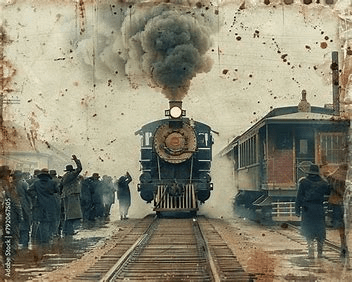
The American frontier was one hell of a place.
Before 1876, even finding food as a high-society passenger in one of the fancy railroad cars headed out west was a nightmare.
Your only choice was one of the many roadhouses located every 100 miles away from each other…at each water stop located along the railroad route.
Food found at these roadhouses was not worth writing home about. These establishments had a reputation of serving rancid meat, cold beans and week-old coffee.
Fred Harvey, a freight agent for the Burlington Railroad, recognized the need for higher-quality food and service establishments along the railroad routes.
He approached the “higher-ups” at Burlington, where he worked as a freight agent, about establishing a network of quality dining stops along their routes.
Burlington rejected his idea.
However, the Atchison, Topeka and Sante Fe Railway (AT&SF) saw the potential and agreed to experiment with his idea.
Harvey began with the 20-seat lunchroom at the Topeka, Kansas depot.
Both railroad officials and passengers were quickly impressed with the high-quality food and first-class service that Harvey brought into the venue.
This simple 20=seat depot lunchroom was the first establishment in what would eventually become the first restaurant chain in the United States.
AT&SF gave Harvey unlimited funds to establish a network of Fred Harvey “eating houses” in prominent locations along its entire route.
The AT&SF brought fresh meat and produce from every corner otf the United States to each Harvey House free-of-charge through its own private line of refrigerator cars, The Santa Fe Refrigerator Dispatch.
The AT&SF maintained two dairy facilities, including one in Las Vegas, to make sure that there was a consistent and adequate supply of fresh milk.
The meals were served in sumptuous portions that provided a good value for the traveling public. For example, pies were cut into fourths, instead of the traditional sixths.
The meals were served on fine China and Irish linens.
The establishments were maintained by fastidious innkeepers who set high standards for efficiency and cleanliness.
Harvey himself inspected these establishments often. Nothing escaped his notice. He was even known to completely overturn a poorly set table.
The Harvey Girls
Harvey placed ads in newspapers throughout the East Coast and Midwest seeking to hire “white, young women, 18–30 years of age, of good character, attractive and intelligent.”
He sought to hire an all-female serving staff for each of these establishments.
Thousands of young women saw this as the perfect opportunity to become a “liberated” adult.
Yes, being a Harvey Girl meant wearing the dreaded uniform: the official starched black and white uniform consisting of a skirt hemmed no more than eight inches from the floor, “Elsie” collars, opaque black stockings, black shoes and a hair net tied with a regulation white ribbon.
Yes, being a Harvey girl meant no longer wearing makeup or chewing gum, at least while on duty.
Yes, being a Harvey girl meant adhering to a strict 10 p.m. curfew.
And yet…
Thousands of single, well-mannered, educated American ladies saw becoming a Harvey girl as the adventure of a lifetime.
Cowboy philosopher Will Rogers once said,
- “In the early days the traveler fed on the buffalo. For doing so, the buffalo got his picture on the nickel. Well, Fred Harvey should have his picture on one side of the dime, and one of his waitresses with her arms full of delicious ham and eggs on the other side, ‘cause they have kept the West supplied with food and wives.”
Harvey died in 1902.
At this time, his family inherited 45 restaurants and 20 dining cars in 12 states.
1892 – The Birth of The Blue Plate
A restaurant menu dated October 22, 1892, contains the term “blue plate,” implying that blue-plate specials were regular features at Harvey Houses in the late 19th century.
- This is supposedly the first use of the term “blue plate”…a term that would become quite popular thirty years later.
 Bless Her Heart
Leave a comment