
If you haven’t already stopped and stood in awe and wonder at many of the buildings that you’ve seen so far on this trek along the Gulf Coast, you’ve either had your head buried in a book …or told Jesus to “take the wheel” while you yourself took a very long nap.
And if you truly appreciate architecture, you must visit the Charnley-Norwood House in Gulfport…one of only four Mississippi houses with a connection to Frank Lloyd Wright.
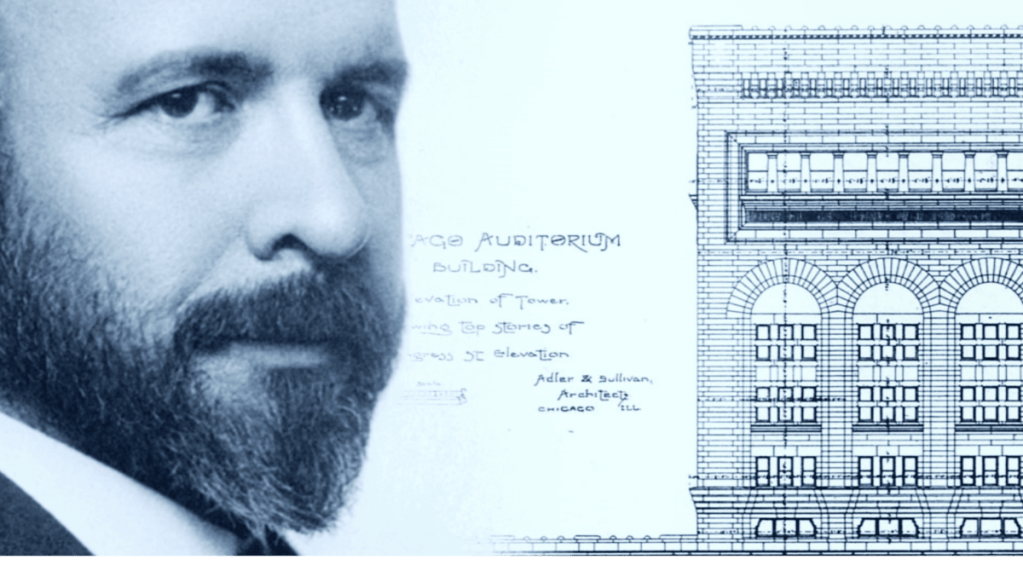
Louis Sullivan, known as the “father of the skyscraper,” was an architect in Chicago. He was well known for his high-rise urban buildings.
While vacationing in New Orleans, Sullivan ran into James Charnley, a lumber baron who also lived in Chicago.
He and his wife had just spent time exploring the Mississippi Gulf Coast. They encouraged Sullivan to visit it out for himself.
Sullivan headed to the Mississippi Gulf Coast…and, like so many other people vacationing along the Mississippi Gulf Coast, completely fell in love with all that the area had to offer.
Sullivan and Charnley bought two adjacent pieces of ocean-front property in what was then the small village of Ocean Springs.

Many prosperous northerners seeking escape from harsh winters and crazy urban living had begun buying land in the South to build vacation homes. After all, a train trip from Chicago to Ocean Springs only took 24 hours to complete during the end of the nineteenth century.
Work soon began on their two “vacation homes.”

Charnley’s “vacation home” was a 3,000 square-foot home, complete with an octagonal guesthouse and stables, that the couple referred to as Charmleigh, meaning “Charming Meadow.”
Sullivan’s “vacation home” was a bungalow, complete with a cistern-tower, servant quarters and stables.
These two homes existed in an area that was relatively undeveloped at the time. There were few houses located near the Eastern Beach of Biloxi Bay. The area was surrounded by wood and wetland.
In March 1896, Charnley sold the property to Fredrick W. Norwood. Norwood, a Chicago lumber magnate, had already established general merchandise and lumber business ties in nearby Brookhaven, Mississippi.
Norwood named the estate ‘Bon Silene.’ The words “Bon Silene” mean “Good Salt Water” or “Good Salt Marsh.” The Norwoods would later plant blush-pink, ruffled Bon Silene roses grown in its gardens.
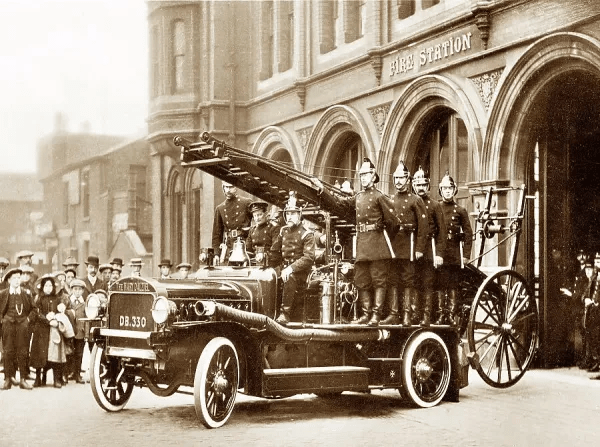
Early in the morning on February 18, 1897, during the Norwood’s first winter visit to the home, a tragic fire started that eventually destroyed the home.
Norwood immediately began having his house rebuilt, following the original plans to the letter, other than a few minor improvements suggested by Sullivan.
For over a century, the two homes proudly stood as reminders of simpler, earlier times.

However, the two homes were finally beaten down by the brutal throws of Hurricane Katrina on August 29, 2005.
Hurricane Katrina destroyed Sullivan’s home.
Norwood’s home sustained heavy damage, but the structure was found to be amazingly intact.
Though initially slated for demolition, the Mississippi Department of Archives and History (MDAH) enlisted volunteers from across the country to salvage pieces of the buildings from the piles of debris that remained on the property.
These recovered pieces were stored in large metal containers at the back of the complex.
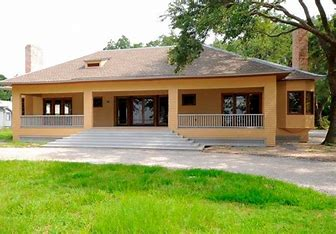
In 2011, the Mississippi Department of Marine Resources purchased the house and property for $1.4 million through the federal Coastal Impact Assistance Program (CIAP). MDAH contributed $300,000.
Contractor J.O. Collins completed the home restoration in 2013…under the supervision of Albert and Associates Architects and the Mississippi Department of Archives and History Gulf Coast Field Office staff.
The Mississippi Department of Archives and History erected a historical marker at the site in 2016.
Today, the Gulf Coast National Heritage Area Program manages the property under the MDMR.
The National Heritage Area is a program designation though the United States National Park Service that recognizes conservation and preservation of historic properties.
Connection with Frank Lloyd Wright
During his lifetime, Frank Lloyd Wright built 532 homes, museums and office buildings.
Only four of these homes were built in Mississippi.
Two of these homes were destroyed by hurricanes: the Welbie L. Fuller residence in Pass Christian was destroyed by Hurricane Camille….the Louis Sullivan Bungalow, built here in Ocean Springs, was destroyed by Hurricane Katrina.
A third home, called Fountainhead, was built in Jackson. This was a private residence.
However, the house has just been put up for sale last week. The asking price is currently $2.5 million.
The fourth home, Charnley-Norwood in Ocean Springs, is currently the only one of these homes open to the public.
So who actually designed the house?
Supposedly both Louis Sullivan and Frank Lloyd Wright, often called the “father of modern architecture,” have claimed credit for designing this home.
Frank Lloyd Wright, often called the “father of modern architecture” was a young draftsman working at the same architecture firm at the time that the house was built.
Some critics claim that Wright could not have designed the house. He never even once visited the site.
In 1924, Sullivan wrote in his autobiography entitled The Autobiography of an Idea that he “planned for two shacks or bungalows, 300 feet apart, with stables far back.”
However, Wright wrote in his Genius and the Mobocracy that Sullivan “remained away for six weeks at Ocean Springs, Mississippi, in the country house I had designed for him” and that Sullivan’s rose garden was “next door to his beloved friends the Charnleys for whom I had drawn a cottage.”
Most historians have come to the belief that this was a collaboration between the two architects.
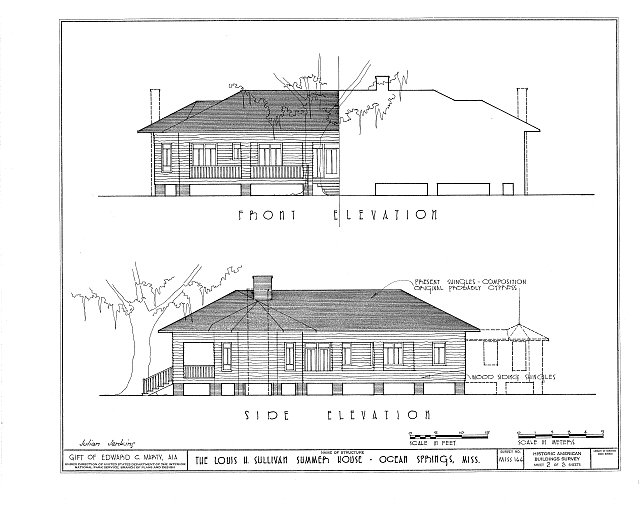
So what does this have to do with architecture today?
Regardless, the Charnley-Norwood House helped usher in new ideas in residential design and should be recognized for this significant contribution.
In a time when most homes being built were Victorian, these new bungalow-style homes were strikingly different.
These differences would eventually reshape residential architecture during the next century – not only in America, but around the world.
Here are a few characteristics that made these new-fangled Bungalow-style homes so much different:
Functionality: The bungalow places functionality at the forefront of design in a way that had not previously been done.
Large roof overhangs and covered porches located along the sides of the bungalow provide protection from the harsh, Southern sun. This is especially helpful, given that Mississippi summers are typically hot and muggy.
The design of the home provides comfort to residents throughout the year.
The many large glass windows and doors in the house offer a great view of the serene setting of the home.
But more importantly, they efficiently distribute both onshore and offshore breezes throughout the home to keep the house cool.
Fireplaces in each bedroom, the entry hall and the dining room make the home comfortable during the cooler winter temperatures.
Horizontal Lines: The home features strong horizontal lines in the attempt to orient the house so that it blends into its natural surroundings.
Lavish Use of Glass: The main goal of the bungalow style is to remove barriers between the interior and exterior of the house. In this house, 27 large exterior doors and many windows enhance cross ventilation. A plethora of windows showers natural light into each room.
Openness: Rooms in a bungalow flow directly from one room into the next. This T-shaped home features living quarters at the front and middle of the design. Servants’ spaces, a kitchen and storage are located at the rear.
Use of Natural and Local Materials: Pine paneling appears on all the walls, floors and ceilings throughout. The exterior walls are clad using wood shingles. The heart and curly pine used in this house most likely came from Norwood’s own lumber mills located near Brookhaven.
Tips for Travelers
Charnley–Norwood House is located at 509 East Beach Drive…on an acre of beachfront property nested along an entire strip of beachfront homes.
The home is open daily to the public, except for Sunday…(this is the Bible belt, right(?!))…
Tours are available Monday-Saturday at 10 am or 3 pm, by appointment only.
Admission is free.
 Bless Her Heart
Leave a comment